Managed Wi-Fi hotspot systems for hostels, estates, hotels and schools. Buy a ready-to-deploy kit, or get the plan and build it yourself.
You supply the internet line. We handle everything that turns it into a network you can charge for.
| SAPS Hub Starter | ₦550,000 |
| SAPS Hub Starter Pro | ₦600,000 |
| Starter, no power backup | ₦399,999 |
| Starter Pro, no power backup | ₦449,999 |
| SAPS Hub DC Enclosure | ₦99,999 |
| Build-your-own blueprint | ₦60,000 |
| Hotspot training | ₦50,000 |
| Network consultation | ₦30,000 |
| Quick questions session | ₦5,000 |
| Custom deployment | from ₦300,000 |
Every price on this site is what you pay. Delivery, installation and internet subscription are quoted separately.
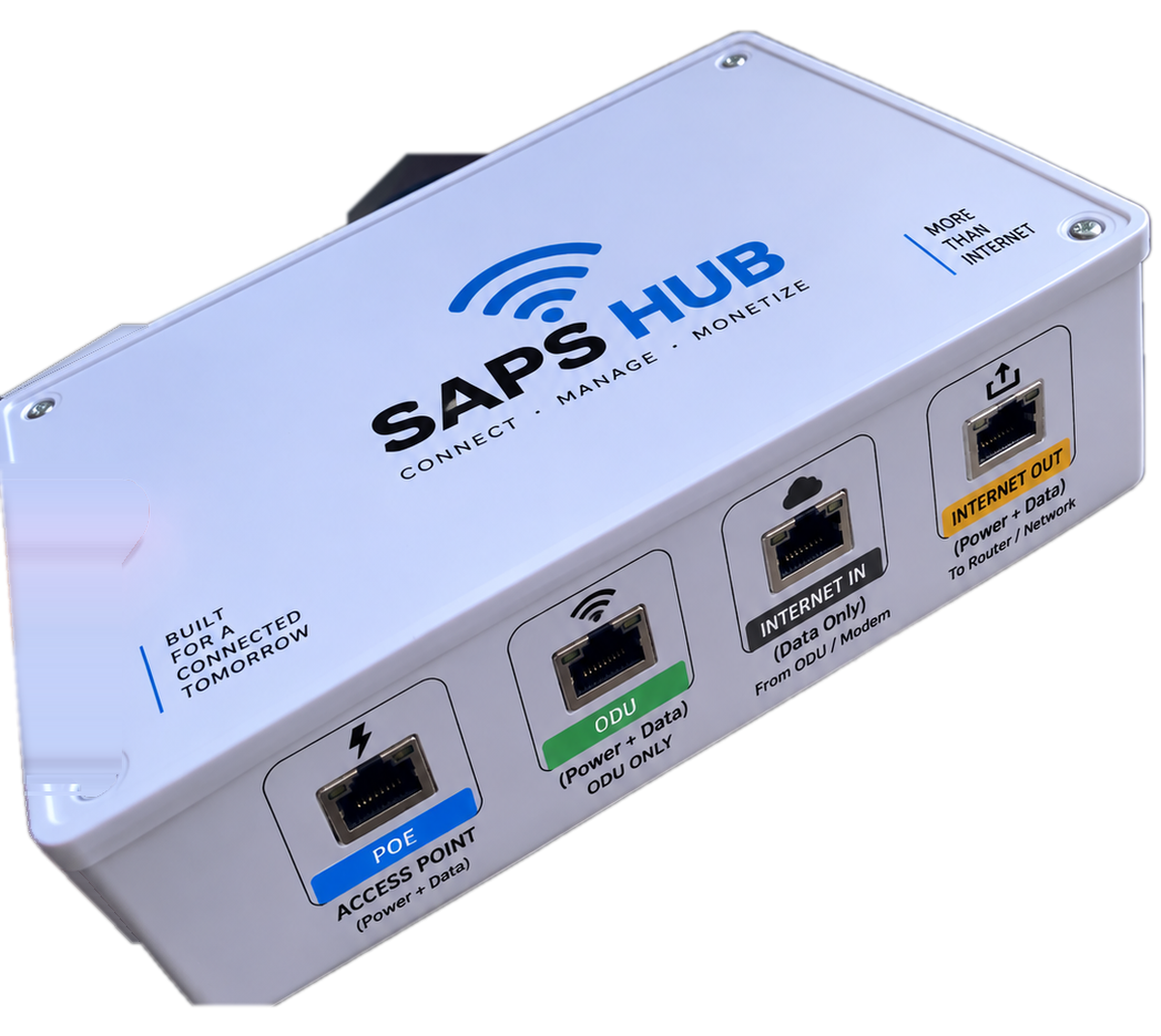
Every SAPS Hub system is built around this box.
The wiring, the fusing and the power distribution are already inside. The ports are labelled on the outside — access point, ODU, internet in, internet out — so anyone who opens the site cupboard in two years can still tell what goes where.
Buy it on its own and put your own hardware in it, or buy it as a complete system with the router, access point and power already fitted and configured.
Not renders. Actual SAPS Data Hub installations on real sites in Nigeria.
Every site is different. These show the work, not a promise about your own building's coverage.
SAPS Data Hub has deployed over twenty hotspot businesses across Nigeria — in Abuja, Kaduna, Port Harcourt, Bayelsa and elsewhere.
That matters for one reason: the things that go wrong on these sites are boring and repetitive. Power that does not last the night. An access point mounted where it looks tidy instead of where it works. A router that cannot keep one heavy user from eating the whole line. We have met all of them already, on somebody else's site, at somebody else's expense.
Pick the one that sounds like you. It saves us both a long back-and-forth in the DMs.
Already ordered something? Check your order.
Same idea at five levels. All of them are bring-your-own-internet systems.
The complete entry-level system, including backup power and solar.
Higher capacity and more room for expansion, for a busier site.
The same Starter system, minus the battery and panel. For sites that already have power sorted.
The Pro build without the battery and panel. You bring your own power.
The box on its own — wired, fused and labelled. Bring your own hardware.
*Planning ranges only. Actual coverage depends on site conditions.
The Pro is not automatically better everywhere. A small compound does not get better service from a bigger access point. And if you already own hardware or have power sorted, do not pay twice for it.
| Feature | Enclosure | Starter no power | Starter | Pro no power | Starter Pro |
|---|---|---|---|---|---|
| Price | ₦99,999 | ₦399,999 | ₦550,000 | ₦449,999 | ₦600,000 |
| Enclosure | Yes | Yes | Yes | Yes | Yes |
| Router | — | MikroTik | MikroTik | Higher-performance MikroTik | Higher-performance MikroTik |
| Access point | — | EAP110-Outdoor | EAP110-Outdoor | EAP225-Outdoor | EAP225-Outdoor |
| Backup power | — | — | itel PowerGo | — | itel PowerGo Pro |
| Solar | — | — | 100W panel | — | 200W panel |
| Configured for you | — | Yes | Yes | Yes | Yes |
| Coverage | — | ~100–200m* | ~100–200m* | ~150–300m* | ~150–300m* |
| You supply | Everything inside | Power | Internet only | Power | Internet only |
*Planning ranges in favourable open outdoor conditions, not guaranteed performance. Actual coverage depends on mounting height, obstructions, RF interference, configuration and client devices. For indoor or multi-building deployments we recommend a site assessment.
One internet line goes in. Controlled, chargeable access comes out.
Starlink, an MTN or Airtel ODU, fibre — whatever you already pay for.
The MikroTik inside routes the connection and caps how much any one person can take.
The outdoor AP puts that signal across your compound, hostel or shopfront.
They connect through a controlled hotspot rather than one password everyone has shared.
Your internet source determines the available WAN bandwidth. SAPS Hub manages and distributes that connection — it does not create bandwidth that your line does not have.
Move the sliders. These are illustrative gross revenue scenarios — not guaranteed income or profit.
Drag the slider for a rough figure, or type an exact amount in any box. Running costs mean your internet subscription, power, maintenance, and anyone you pay. Be honest with this number — it is the one people leave out.
Illustrative gross revenue scenarios — not guaranteed income or profit. What you actually earn depends on how many people pay, how many keep paying, and what your site costs to run.
You can build a similar system yourself. We are not going to pretend otherwise.
Every component in the kit is available to buy. If you know what to order, how to configure MikroTik, how to set up hotspot access and bandwidth rules, and how to integrate the power, then building it yourself will cost you less money and more time.
SAPS Hub is for people who want an integrated, configured, ready-to-deploy system without sourcing, assembling, configuring and troubleshooting every component themselves.
What you are paying for:
Then do it properly. For ₦60,000 you get a written blueprint for your specific site — hardware list, quantities, where things go, how the power works and indicative costs.
It is the difference between buying the right equipment once and buying the wrong equipment twice.
Build your own system — ₦60,000Planning ranges instead of guarantees, and a plain list of what is not included. You should know what you are buying before you pay.
Payments are processed by Paystack. Your card details go to them, never to us.
Every paid order and session gets its own reference, issued the moment you pay.
Check the status of any order at any time using that number.
These are preorders with a stated fulfilment window. We tell you where your order is rather than going quiet.
A real number, answered by the people who build the systems.
No. Both kits are bring-your-own-internet systems. You supply a Starlink, MTN or Airtel ODU, fibre or other compatible Ethernet-based connection. Your line determines the bandwidth available; the SAPS Hub manages and distributes it.
Possibly, and possibly not. The planning ranges are for favourable open outdoor conditions. Walls, distance, mounting height and interference all change the answer. Multi-building sites usually need additional access points. If the answer matters before you spend money, a consultation or blueprint is the honest way to find out.
It depends on the access point, your bandwidth, what people are doing, the RF environment and the configuration. Light browsing and messaging supports far more people than evening video streaming. We will not give you a fixed number, because a fixed number would be a guess.
Solar charging is designed to supplement the backup power system, not to run the site independently forever. Runtime depends on the connected equipment, your internet source, network traffic, battery state, solar availability, weather and conversion losses.
These are preorders with a fulfilment window of 7–14 working days. If anything changes, we tell you rather than going silent.
No. Both are quoted separately once we know where the kit is going and what the site needs. You can indicate on the order form whether you want an installation quote.
Yes. Both kits are designed to have access points added as demand grows.
No, and nobody can give you that. A hundred people at 20Mbps each is 2,000Mbps of demand — far beyond what any ODU or Starlink line in Nigeria delivers. What actually happens is contention: people are not all pulling at once, so a 100Mbps line can serve a large group comfortably for browsing, messaging and social media. It will feel slow if fifty of them stream video at 9pm. Anyone who promises you a fixed speed per user is either misunderstanding the question or hoping you do.
Then 100Mbps is your ceiling, and everything downstream is about sharing it sensibly. That is what the router configuration is for — limiting how much any one person can take so that one heavy user does not ruin the network for everyone else. More access points increase coverage and the number of devices that can connect; they do not create bandwidth you did not buy.
This is worth taking seriously rather than hand-waving. NCC rules state that Wi-Fi hotspots must be registered and authorised by the Commission, and that commercial hotspot operators must hold an operating licence. Providing communications services without the required licence is an offence under the Nigerian Communications Act. Separately — and more likely to affect you first — most ISP contracts prohibit resale on a residential plan.
In practice, enforcement against small estate and hostel operators is rare, and many people run these networks without incident. But we are not going to tell you it is simply fine. Use a business or commercial plan rather than a home one, read your ISP's terms, and if you are building something large or visible, take proper advice on registration. We are not lawyers and this is not legal advice.
No. That is exactly what the DC Enclosure and the no-power versions exist for. Buy the box on its own and fit your own hardware, or buy a kit without the battery and panel if your power is already sorted. Paying us twice for equipment you already own would be waste, and we would rather sell you the part you actually need.
Multi-WAN setups are possible — the TP-Link ER605 gateway we stock is built for exactly this — but whether it makes sense at your site depends on what you are trying to achieve: failover if one line drops, or combining bandwidth, which behaves differently from how most people expect. Ask us about your specific case rather than assuming either way.
Usually, yes. Most abandoned hotspot setups failed for one of a handful of reasons, and almost none of them are the fault of the person who gave up. Tell us what happened and what equipment you still have — the Quick Questions session exists for precisely this, and it is the cheapest way to find out whether your existing kit can be rescued before you spend anything on new hardware.
Then a kit is the wrong shape of thing. Tell us about the site through the custom deployment form and we will assess and quote it properly.